Walk into any coffee shop today and you’ll hear people talking about ChatGPT, asking Alexa to play music, or scrolling through TikTok videos curated specifically for them.
That’s artificial intelligence for beginners to witness in real life — it’s already everywhere, quietly running in the background of our digital lives.
The surprising part? You don’t need a computer science degree to understand AI. What once felt like distant science fiction has become practical, accessible, and easier to understand when explained clearly.
If you’ve ever wondered what AI really is, how it works, or why it’s suddenly everywhere, this guide explains it in plain English — no heavy jargon, no complex formulas.
What Is Artificial Intelligence, Really?
Artificial intelligence for beginners starts with a simple definition:
AI is computer systems performing tasks that normally require human intelligence.
That includes:
- Recognizing faces in photos
- Understanding spoken commands
- Making content recommendations
- Translating languages
- Detecting fraud
- Assisting with writing or coding
When you unlock your phone with your face — that’s AI.
When Netflix recommends a show — that’s AI.
When spam emails disappear automatically — that’s AI.
Most AI today falls under “narrow AI.”
That means it’s very good at one specific task but cannot think beyond that domain.
The type of AI seen in movies — often called Artificial General Intelligence (AGI) — does not yet exist.
What we have in 2026 are powerful but specialized tools.
The Building Blocks: How AI Actually Learns
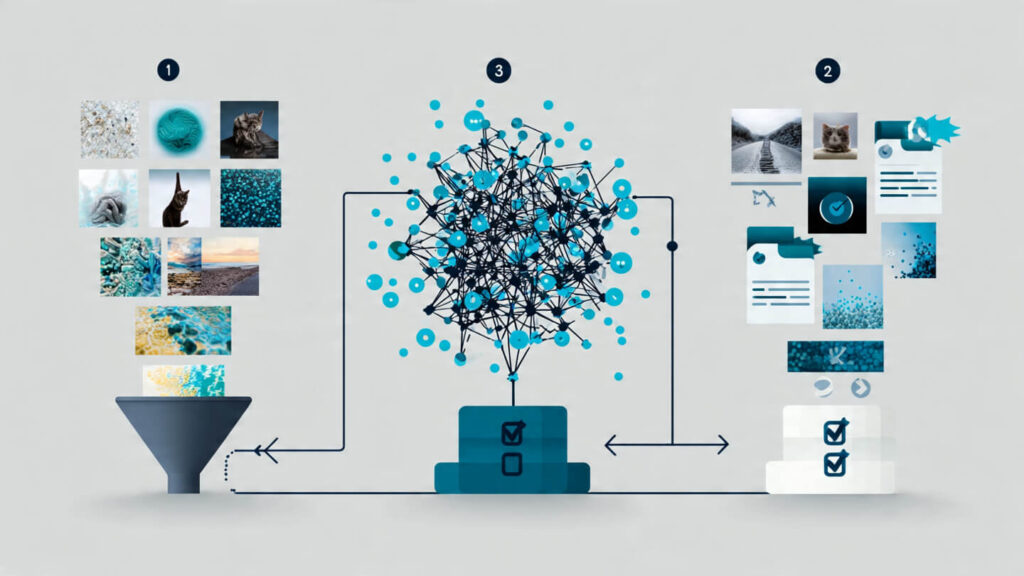
Understanding artificial intelligence for beginners becomes easier when you know how it learns.
AI systems don’t follow rigid instructions for every scenario. Instead, they learn patterns from examples.
Machine Learning
Machine learning allows systems to analyze large datasets and identify patterns.
For example:
If you show a system thousands of images of cats, it learns common features — shapes, textures, patterns — and eventually recognizes new cat images accurately.
No one programs “if whiskers = cat.”
The system learns from data.
Deep Learning
Deep learning uses neural networks inspired by how the human brain processes information.
These multi-layered networks help AI:
- Transcribe speech
- Recognize handwriting
- Detect objects in images
- Translate languages
Your smartphone’s voice-to-text feature works because of deep learning models trained on massive speech datasets.
Natural Language Processing (NLP)
NLP enables AI to understand and generate human language.
It powers:
- ChatGPT
- Siri and Alexa
- Email auto-complete
- Translation apps
AI doesn’t “understand” language the way humans do. It predicts patterns in text based on training data.
That distinction matters.
Types of AI: From Basic to Advanced
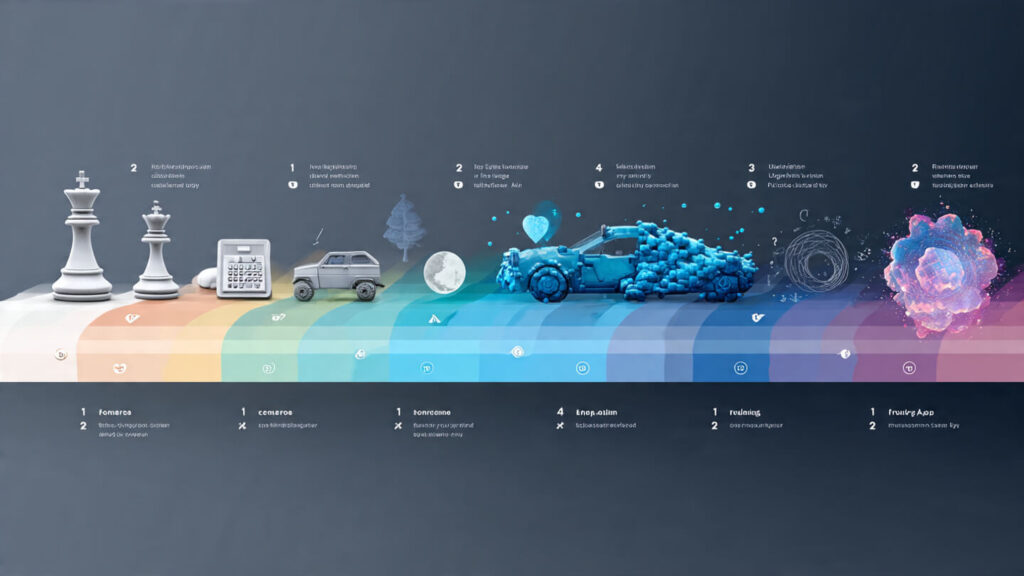
Artificial intelligence for beginners also means understanding capability levels.
1. Reactive Machines
These systems respond to inputs without memory.
Example: Early chess-playing computers.
2. Limited Memory AI
This is what most modern AI systems use.
They rely on past data to improve decisions — like recommendation engines or self-driving systems.
3. Theory of Mind (Research Stage)
AI that could interpret emotions or intentions more deeply. Still under development.
4. Self-Aware AI (Hypothetical)
Fully conscious machines remain science fiction.
We are not close to building conscious AI systems.
Where You’re Already Using AI

Most people interact with AI dozens of times daily without realizing it.
In Healthcare
AI assists doctors by analyzing medical images and identifying patterns that may require attention. It supports — not replaces — professionals.
In Finance
Banks use AI to detect unusual transactions and reduce fraud risks.
In Shopping
E-commerce platforms recommend products based on browsing behavior.
In Entertainment
Streaming platforms analyze viewing patterns to suggest personalized content.
In Customer Service
Chatbots handle routine inquiries, allowing human representatives to focus on complex issues.
AI improves efficiency — but human oversight remains essential.
The 2026 AI Landscape
Generative AI tools can now:
- Write text
- Create images
- Generate code
- Compose music
These systems work by predicting patterns based on massive training datasets.
They can produce impressive outputs — but they do not “think.” They calculate probabilities.
Edge AI is also growing. More devices now process AI tasks locally, improving speed and privacy.
Multimodal AI systems can analyze text, images, and audio together — increasing versatility.
The field is evolving quickly, but expectations should remain realistic.
The Challenges and Limitations
Artificial intelligence for beginners must include honest discussion of risks.
Bias
AI systems learn from historical data. If that data contains bias, the system may reflect it.
Job Disruption
Automation may reduce demand for certain repetitive roles, while creating new technical and oversight positions.
Privacy
AI-driven surveillance and data analysis raise legitimate concerns about monitoring and consent.
Transparency
Some deep learning systems operate as “black boxes,” making decisions difficult to interpret.
Lack of Common Sense
AI does not possess real-world understanding. It recognizes patterns — not meaning.
Understanding these limits helps users apply AI responsibly.
Getting Started With AI
You don’t need technical expertise to begin.
Start by:
- Testing conversational AI tools
- Using AI writing assistants
- Exploring recommendation systems
- Observing how AI improves or misfires
Pay attention to limitations. AI-generated responses may sound confident but contain factual errors.
Critical thinking remains essential.
The Bottom Line
Artificial intelligence for beginners comes down to this:
AI is advanced pattern recognition and prediction — not human-level intelligence.
The systems available in 2026 are powerful specialists. They automate tasks, improve efficiency, and support decision-making.
But they are tools — not replacements for human reasoning.
Understanding what AI can and cannot do gives you an advantage in an increasingly AI-integrated world.
The AI revolution isn’t coming.
It’s already here.
The real question is whether you’re ready to use it wisely.
☕ Buy Me a Coffee


Pingback: NVIDIA's AI Gamble: How the Chip Giant Is Betting Everything on Intelligence Over Graphics - The Evident