When Elon Musk replies with a simple “Yes” on X (formerly Twitter), the tech world tends to pause. In early 2026, one such reply confirmed what many developers had been watching closely: Grok 3 open source is planned.
This isn’t just another AI announcement buried in a corporate blog. It signals xAI’s intention to release one of its most capable large language models to the public — at a time when the AI industry is facing intense regulatory scrutiny, explosive investment, and a rapidly growing open-source movement.
The timing is notable. xAI recently closed a massive funding round reportedly valued at tens of billions of dollars, governments across the US, EU, and Asia are increasing oversight of AI systems, and competition between OpenAI, Google, Meta, and emerging labs is accelerating fast.
So why would xAI choose this moment to open source Grok 3? And what does it realistically mean for developers and businesses?
Let’s break it down.
From Grok 1 to Grok 3: xAI’s Open-Source Pattern
xAI’s move toward open source didn’t start with Grok 3.
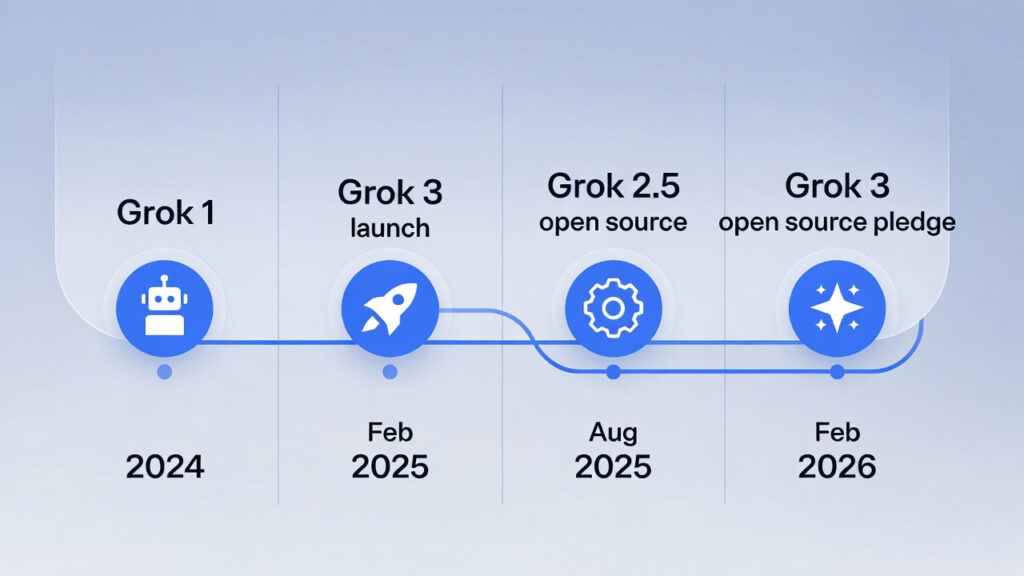
- Grok 1 was released to the open-source community in 2024, reinforcing Elon Musk’s public stance on AI transparency.
- Grok 2.5 followed in August 2025, published with model weights and architecture via Hugging Face.
- Around that time, Musk indicated that Grok 3 would follow a similar open-source path, roughly six months after its initial release.
Grok 3 itself launched in early 2025 and was trained on xAI’s “Colossus” compute cluster, reportedly involving hundreds of thousands of Nvidia GPUs. According to xAI, the model represents a major leap in reasoning, coding, and multimodal capability compared to earlier versions.
xAI’s strategy appears consistent:
release the previous generation once the next model is production-ready. This approach builds trust with developers while still allowing the company to maintain a short-term competitive edge.
Why Grok 3 Open Source Matters (Beyond the Hype)
Not all “open-source AI” is equally useful. Many models are released with restrictive licenses, incomplete documentation, or hardware requirements that make them inaccessible outside large organizations.
Grok 3 open source stands out for several reasons.
Real-Time Information Capabilities
Grok is designed to integrate real-time data from X. While developers will still need to implement their own data pipelines, the architecture is optimized for current-information workflows — something many open models struggle with.
Native Multimodal Design
Rather than treating images or code as add-ons, Grok 3 is built to handle text, code, and images in a unified way. This opens doors for applications like document analysis, visual reasoning, and advanced developer tooling.
Competitive Performance
Based on early demonstrations and developer feedback from previous Grok releases, Grok 3 appears competitive with top-tier proprietary models in areas such as reasoning and math. While independent benchmarks will ultimately tell the full story, expectations are high.
For independent developers and small teams, this is significant. Open access means:
- No per-token API fees
- No forced vendor lock-in
- Full control over deployment and fine-tuning
The Funding Context: How $20B+ Enables Open Source
xAI’s open-source decision makes more sense when viewed alongside its financing.
Reports indicate that xAI recently raised over $20 billion, with backing from major technology and infrastructure players. Much of this capital is reportedly allocated toward compute — GPU leasing, new data centers, and next-generation training clusters.
In other words, Grok 3 open source doesn’t represent a retreat. It reflects confidence.
The model being released is not the end of xAI’s roadmap. Future versions (often referred to as Grok 4 and Grok 5 in public discussions) are already in development. Open-sourcing Grok 3 helps:
- Attract developers and researchers
- Surface real-world edge cases
- Accelerate ecosystem adoption
- Strengthen xAI’s long-term platform value
This “ecosystem flywheel” approach mirrors strategies that helped Linux, Android, and Kubernetes dominate their respective spaces.
Regulatory Pressure and Strategic Transparency
xAI and X have faced growing scrutiny worldwide, including:
- EU Digital Services Act obligations
- Legal challenges related to content moderation
- Investigations into AI safety and data handling practices
Open-sourcing Grok 3 serves a strategic purpose here.
When a model’s architecture and behavior are public, claims of opaque or “black box” AI systems are harder to sustain. Developers, researchers, and regulators can independently evaluate how the system works.
This move aligns with xAI’s broader transparency efforts, including the decision to open source parts of X’s recommendation algorithms earlier in 2026.
How Developers Can Prepare for Grok 3 Open Source
While the full release details are still pending, developers can prepare now.
1. Environment Setup
- Python 3.10+
- PyTorch
- Hugging Face Transformers
- Optional: Google Colab for early testing
2. Hardware Expectations
Grok 3 is expected to be a very large model. Full-precision weights may require hundreds of gigabytes of storage. Many developers will likely rely on:
- Quantized versions (4-bit / 8-bit)
- Cloud GPU providers
- Adapter-based fine-tuning (LoRA / QLoRA)
3. Deployment Options
- Local inference for research
- Cloud hosting for production
- API wrappers using FastAPI or similar frameworks
Frameworks like LangChain and vector databases such as Pinecone or FAISS can be used to build retrieval-augmented systems without retraining the full model.
Real-World Use Cases Emerging from Open Models
Based on previous Grok releases and similar large open-source models, likely applications include:
- AI-assisted customer support
- Market and sentiment analysis
- Developer tools and code review assistants
- Personalized content systems
- Internal knowledge search for businesses
The key advantage is control. Organizations can adapt the model to their data and compliance requirements without depending on external APIs.
Challenges You Should Not Ignore
Open-sourcing a model like Grok 3 doesn’t eliminate responsibility.
- Compute costs can still be high
- Safety filtering becomes the deployer’s responsibility
- Regulatory compliance (GDPR, CCPA, sector rules) still applies
- Misuse risks exist, especially without proper guardrails
These challenges are manageable — but they require planning.
What Grok 3 Open Source Signals for the AI Industry
This release fits into broader 2026 trends:
- Growth of agentic AI systems
- Domain-specific fine-tuned models
- Increased reliance on open foundations
- Regional AI deployment strategies driven by regulation
If xAI continues this pattern, open-source Grok models could become a foundational layer for many future AI products.
Final Thoughts: Build, Don’t Just Watch
Grok 3 open source isn’t just news — it’s an opportunity.
Developers should start identifying real problems that current tools don’t solve well. Businesses should explore pilot projects before competitors do. The biggest advantage of open source isn’t cost — it’s freedom.
When the release lands on GitHub or Hugging Face, the ecosystem will move fast. Being prepared matters.
The frontier is opening again. What you build next is up to you.
About the Author
LKSD is an independent tech writer and web publisher at EvidentWeb.com.
☕ Buy Me a Coffee