Gravity Bends Time: The Complete Guide to Gravitational Time Dilation
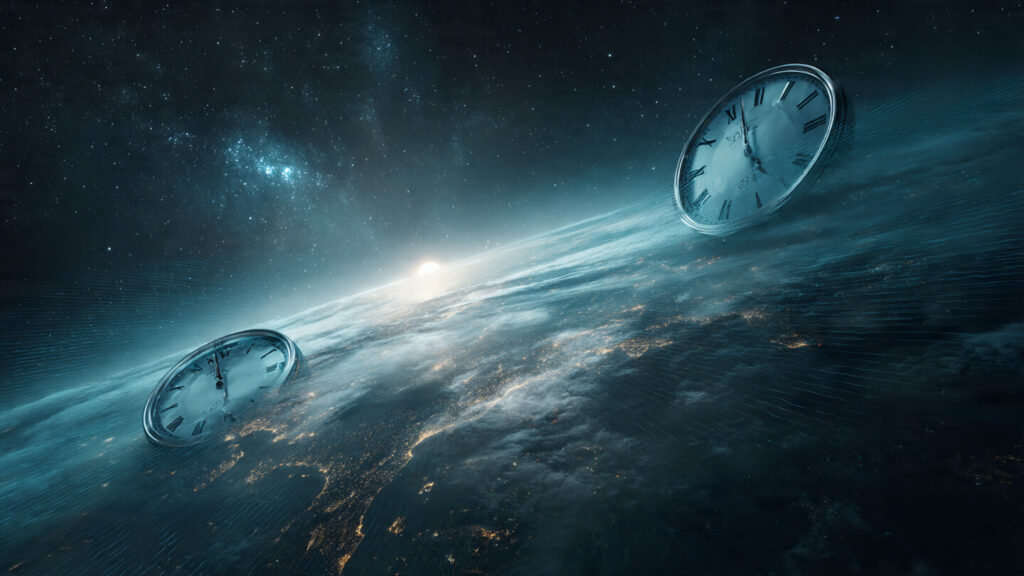
Imagine placing two identical atomic clocks side by side — then sending one to the top of a tall building. When it comes back down, it will have ticked ahead of the clock that stayed on the ground. Not by much. Barely a few nanoseconds. But the difference is real, measured, and repeatable. That is gravitational time dilation in its most ordinary form, and it is one of the strangest confirmed truths in all of physics.
Time does not pass at the same rate everywhere. Gravity warps not just space but time itself, slowing clocks the deeper they sit inside a gravitational field. The stronger the pull, the slower the tick. This is not a theoretical curiosity — it is baked into the GPS system on your phone, confirmed in precision lab experiments, and stretched to mind-bending extremes near black holes.
Einstein predicted all of this in 1915. Over a century later, every test we have thrown at his equations has only confirmed them further. Here is everything you need to understand gravitational time dilation — the science, the proof, the practical consequences, and the cosmic edge cases that still stagger physicists today.
What Is Gravitational Time Dilation? The Core Concept Explained
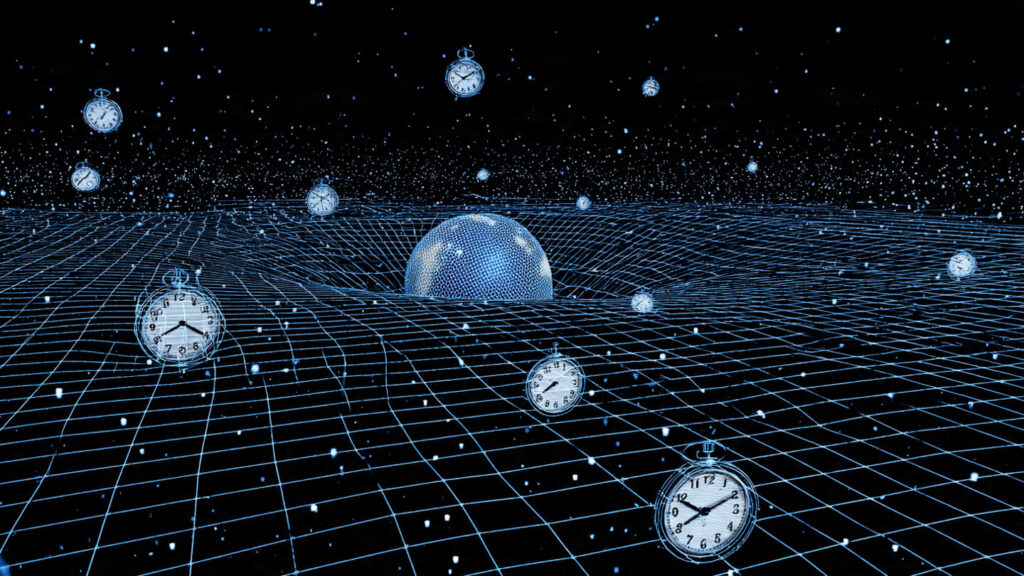
Newton pictured gravity as a force — an invisible pull that reaches across empty space and drags objects together. Einstein replaced that picture entirely. In his general relativity, gravity is spacetime curvature caused by mass. Heavy objects like Earth don’t pull you down; they warp the fabric of spacetime around them, and you follow the natural curve of that warped geometry.
The critical insight is that spacetime includes time. When a massive object curves space, it also curves time. The more spacetime is curved at a given location, the more slowly time flows there relative to somewhere farther from the mass. A clock sitting on Earth’s surface literally runs slower than a clock floating in deep space. Both clocks are working perfectly — local time always feels normal — but compared to each other, the deeper clock consistently lags.
The relationship is captured in a simplified version of the Schwarzschild metric: t’ = t × √(1 − 2GM/rc²). Here, G is the gravitational constant, M is the mass of the object, r is the distance from its center, and c is the speed of light. The larger the ratio GM/rc², the more time slows down. For Earth at sea level, the factor is tiny but non-zero — and measurable.
Gravitational Redshift: Time Dilation You Can See in Light
Gravitational time dilation has a visible companion effect: gravitational redshift. When light climbs out of a gravitational well — escaping the pull of a massive object — it loses energy. Lower energy means a longer wavelength, which means the light shifts toward the red end of the spectrum. This is not just a quirk of light. It is time dilation expressed through photons. Light emitted deep in a gravity well ticks at the slower clock rate, so its frequency appears lower to distant observers.
Robert Pound and Glen Rebka confirmed this in 1959 by measuring the tiny frequency shift of gamma rays traveling up a 22-meter tower at Harvard. The result matched Einstein’s prediction to within 10%. Two decades of refinement brought that agreement to within 1%. Gravity redshifts light, and time dilation gravity produces is the reason why.
Einstein’s General Relativity and the Origin of Time Dilation Gravity Creates
Before 1905, space and time were separate stages on which physics played out. Einstein’s special relativity fused them into spacetime — a four-dimensional fabric where the faster you move through space, the slower you move through time. That is velocity-based time dilation, and it applies symmetrically: two observers moving relative to each other each see the other’s clock running slow.
General relativity, published a decade later in 1915, added gravity to the picture. Mass and energy curve spacetime, and that curvature is what we experience as gravity. Crucially, the gravitational version of time dilation is not symmetric. When a clock near a massive object runs slower than a distant one, both observers agree on which clock is slower. The deeper clock lags, full stop. There is no reference frame in which this reverses.
This asymmetry is philosophically remarkable. Velocity dilation depends on relative motion. Gravitational dilation depends on position in a gravitational field — an absolute feature of your location in curved spacetime. Einstein did not just predict this effect; his field equations make it a mathematical necessity. There is no version of general relativity without gravitational time dilation.
Real-World Experiments That Proved Gravitational Time Dilation
Theory only goes so far. What makes gravitational time dilation one of the best-tested predictions in all of science is the sheer pile-up of confirming experiments across different technologies, locations, and scales.
The Pound-Rebka Experiment (1959)
The first direct laboratory confirmation of gravitational redshift — and by extension, gravitational time dilation — came from Harvard’s Jefferson Laboratory. Pound and Rebka measured the frequency shift of gamma rays over a 22-meter vertical drop. The upper detector registered a slightly higher frequency than the lower emitter, exactly as general relativity predicted. It was the first time anyone had measured spacetime curvature in a building-sized apparatus.
Gravity Probe A (1976)
NASA launched a hydrogen maser clock on a Scout rocket to an altitude of about 10,000 km. Comparing it to an identical ground clock, the airborne maser ran faster by precisely the amount general relativity predicted — to an accuracy of 70 parts per million. At the time, it was the most precise confirmation of the gravitational redshift ever achieved.
NIST Atomic Clock Experiments (2010 — Present)
Researchers at the National Institute of Standards and Technology demonstrated gravitational time dilation over a vertical distance of just one centimeter using aluminum-ion optical clocks. Moving one clock by 33 centimeters produced a detectable rate difference. More recently, strontium lattice clocks have verified the effect with fractional uncertainties approaching one part in 10^18. These are the most precise measurements of gravitational time dilation ever recorded, and they match Einstein’s equations every single time.
The Hafele-Keating Experiment (1971)
Physicists Joseph Hafele and Richard Keating flew cesium atomic clocks around the world on commercial airplanes and compared them to stationary ground clocks. The traveling clocks experienced both velocity-based dilation (flying fast) and gravitational dilation (flying high). The net results matched the combined prediction of special and general relativity within experimental uncertainty. Ordinary jet travel produces measurable time differences.
Gravitational Time Dilation by Scenario
| Scenario | Time Dilation Effect | Direction | Real-World Example |
| Sea Level vs. Mt. Everest | ~30 microseconds/year faster at peak | Higher = faster | Atomic clock comparisons |
| GPS Satellite Orbit (~20,000 km) | 38 microseconds/day net faster | Higher = faster | Pre-adjusted GPS clocks |
| Commercial Airplane Flight | Nanoseconds per flight | Slightly faster (height dominates) | Hafele-Keating experiment |
| ISS Astronaut (6 months) | ~0.01 seconds younger | Slower (speed > altitude effect) | Scott Kelly vs. twin Mark |
| Near a Neutron Star | Seconds per Earth day | Dramatically slower | Pulsar timing observations |
| Black Hole Event Horizon | Effectively frozen for outsider | Time stops relative to infinity | Theoretical / LIGO data |
GPS: Where Gravitational Time Dilation Pays the Bills
Nothing makes gravitational time dilation feel more real than knowing your phone’s navigation depends on it. GPS satellites orbit at roughly 20,200 kilometers above Earth’s surface, where gravity is much weaker than at sea level. As a result, their clocks tick faster than ground clocks by about 45 microseconds per day due to gravitational dilation alone.
But the satellites are also moving fast — around 3.9 km/s — which slows their clocks by roughly 7 microseconds per day due to velocity-based time dilation from special relativity. The net effect is that GPS satellite clocks run about 38 microseconds faster per day than ground clocks.
Thirty-eight microseconds sounds trivial. But at the speed of light, a 38-microsecond error translates to a position error of roughly 11 kilometers per day. If engineers did not pre-rate GPS satellite clocks to compensate, your navigation app would drift to uselessness within hours. The entire GPS system is, in a very practical sense, an applied relativity machine. Einstein’s spacetime curvature is not just an academic abstraction — it is what makes turn-by-turn directions work.
Cosmic Extremes: Black Holes and the Edge of Time
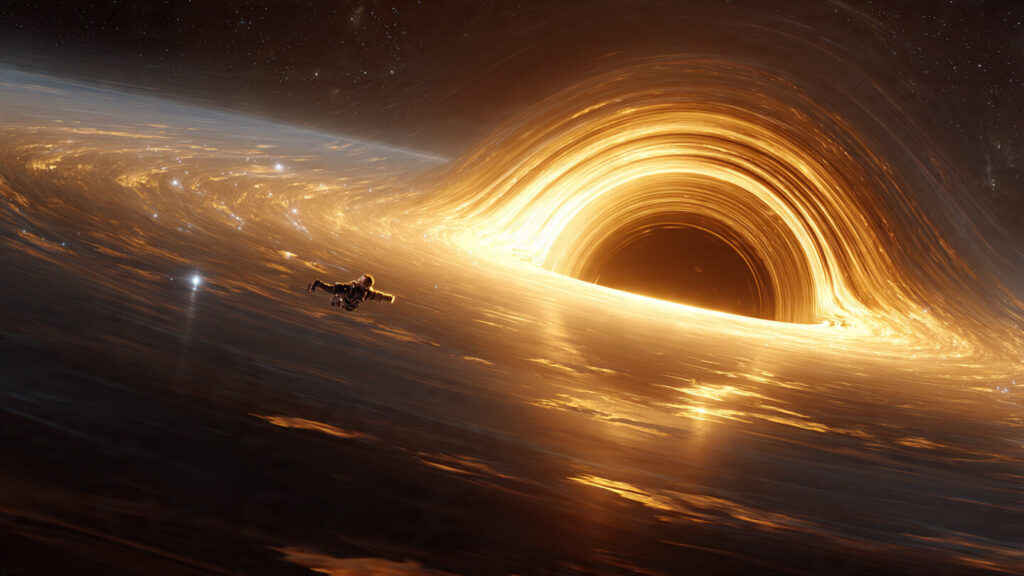
If Earth’s mild gravity slows clocks by nanoseconds per day, what happens near objects with gravity millions of times stronger? Near a stellar-mass black hole, gravitational time dilation becomes extreme in ways that strain intuition.
At the event horizon — the point of no return — gravitational time dilation reaches its theoretical maximum. A clock hovering just outside the event horizon would appear, from far away, to have nearly stopped. Photons climbing out of that region are so severely redshifted they become undetectable. For someone falling in, nothing feels strange locally — time passes normally. But the outside universe ages enormously while they cross the threshold.
This is not science fiction. The supermassive black hole at our galaxy’s center, Sagittarius A*, contains roughly 4 million solar masses. Stars orbiting it at close range experience measurable gravitational time dilation. LIGO’s detection of gravitational waves since 2015 has given us a new way to probe these extreme spacetime curvatures, offering indirect but powerful evidence that general relativity holds even in the most violent spacetime environments imaginable.
Neutron Stars and the Middle Ground
Between Earth and a black hole lie neutron stars — collapsed stellar cores that pack a sun’s worth of mass into a sphere roughly 20 kilometers across. Their surface gravity is around 200 billion times Earth’s. A clock on a neutron star’s surface would run roughly 30% slower than one far away. Millisecond pulsars — neutron stars spinning hundreds of times per second — provide some of the most precise natural clocks in the universe, and their timing data has been used to test general relativity to extraordinary precision.
Everyday Insights: How Gravitational Time Dilation Touches Your Life
Most of us will never orbit a neutron star or fall into a black hole. But gravitational time dilation is quietly part of daily life in ways that are easy to miss.
Every time you use navigation on your phone, you are benefiting from engineers who accounted for Einstein’s equations. Every time physicists synchronize atomic clocks across different altitudes, they correct for the height-dependent ticking rate. Even the muons created by cosmic rays striking the upper atmosphere live longer than their short half-lives would predict — partly because they fall into a stronger gravitational field as they descend, though velocity dilation from special relativity dominates that particular effect.
There is something quietly profound about this. The watch on your wrist runs at a slightly different rate depending on whether you are at sea level or standing on a mountain. The difference is far too small to notice with ordinary timekeepers, but it is real. Time is not a single universal river flowing at the same rate everywhere. It is a local property of spacetime, shaped by whatever mass happens to be nearby. That flips the intuitive human model of time completely upside down.
Practical Tips: Explore Time Dilation Yourself
You do not need a research lab to engage with these ideas meaningfully. A few practical entry points:
- Use an online gravitational time dilation calculator — plug in Earth’s mass (5.972 × 10^24 kg) and vary the altitude to see how the dilation factor changes with height.
- Read up on the NIST atomic clock experiments — their public-facing write-ups are accessible and explain how they detect sub-centimeter height differences using optical clocks.
- Track the GPS correction story — the fact that GPS clocks are pre-rated to compensate for relativistic effects is documented in multiple NASA and NIST publications and makes for compelling reading.
- Watch LIGO’s real-time data streams when a gravitational wave event is announced — you are watching ripples in the spacetime fabric that momentarily dilate time across entire regions of space.
Gravity Bends Time — and That Changes Everything
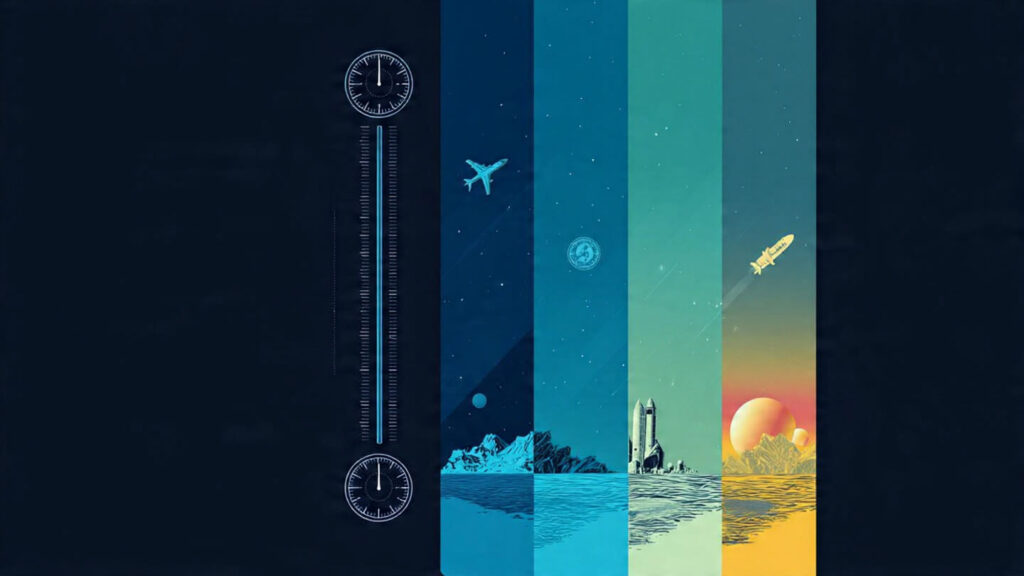
Gravitational time dilation is one of those rare scientific facts that sounds like philosophy until you realize it is engineering. Gravity bends time. Clocks run slower in deeper gravitational fields. Einstein derived this from pure mathematical reasoning about curved spacetime, and every precision measurement since has confirmed it — from gamma rays in a Harvard stairwell to aluminum-ion clocks separated by a centimeter to the GPS satellites triangulating your position right now.
The deeper implication is harder to shake off: time is not universal. It is a local experience, shaped by the mass of nearby objects and the curvature that mass creates in spacetime. Standing at sea level versus standing on a mountain, you are living in slightly different flows of time. The difference is too small to feel, but not too small to measure.
Understanding gravitational time dilation is not just about memorizing a formula or passing a physics exam. It is about grasping that the universe operates on rules far stranger and richer than ordinary experience suggests. The best way to go deeper is to keep exploring — simulate the numbers, read the original experiments, and follow the ongoing precision tests that continue to probe the edges of what general relativity can and cannot predict.
Curiosity is the real entry point. What aspect of time dilation will you explore first?
References
- Wikipedia contributors. Gravitational time dilation. View
- Wikipedia contributors. Time dilation. View
- Physics World. Gravity’s effect on time confirmed. View article
- National Institute of Standards and Technology (NIST). Putting Einstein to the test. View article
- Smithsonian National Air and Space Museum. The real-life effects of time dilation. View article
- American Physical Society. Physical Review D. DOI Link
☕ Buy Me a Coffee