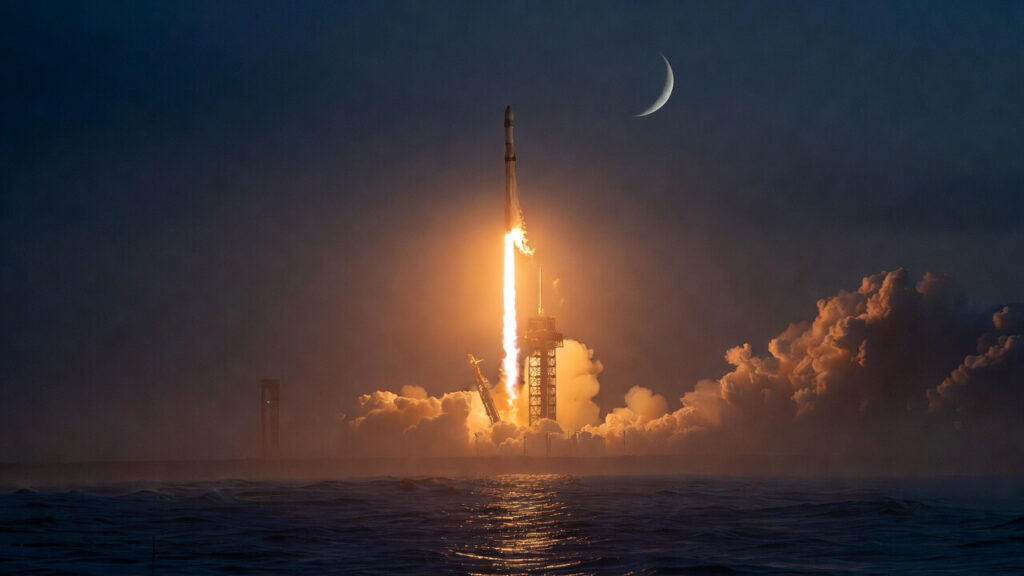
There’s a moment in every space race when history shifts from theory to reality. For NASA’s Artemis program, that moment arrives on March 6, 2026 — the targeted launch date for the Artemis II mission, the first crewed flight of the Space Launch System (SLS), and the first time humans will travel to the vicinity of the Moon since Apollo 17 in 1972.
More than fifty years. One generation’s worth of waiting. And now, finally, four astronauts are strapping in.
If you’ve been casually following the news, you might think this is just another rocket launch. It isn’t. The Artemis II mission is the critical gateway between Earth and the lunar surface — a high-stakes rehearsal that will determine whether the United States (and its international partners) can actually sustain a human presence on and around the Moon. Getting this right isn’t optional. Getting it wrong delays everything that comes after by years.
So let’s break down exactly what’s happening, why it matters enormously, and what you should be watching for.
What Is the Artemis II Mission? A Human Return to Deep Space
The Artemis II mission is the second flight of NASA’s Space Launch System and the first to carry humans. Unlike its predecessor, Artemis I — which completed an uncrewed 25-day test flight in late 2022 — this mission places four real people inside the Orion spacecraft and sends them on a 10-day journey around the Moon.
The flight plan is ambitious but precise. After liftoff from Kennedy Space Center’s Launch Complex 39B, the SLS will thunder into Earth orbit. From there, the Interim Cryogenic Propulsion Stage (ICPS) fires to send Orion on a translunar trajectory. The crew will swing around the far side of the Moon in what’s called a distant retrograde orbit — a gravitationally stable path that takes the spacecraft roughly 8,900 kilometers past the lunar surface before looping back toward Earth. Splashdown is planned off the coast of California.
What makes this more than a scenic trip is its technical purpose. Every system that will eventually keep astronauts alive on the lunar surface gets stress-tested here first: life support, thermal control, navigation, communications across hundreds of thousands of kilometers, and the psychological performance of the crew under genuine deep-space conditions. Artemis II is, in every measurable sense, humanity’s checkout flight for returning to the Moon.
Meet the Crew Who Will Fly Farther Than Any Humans in Decades
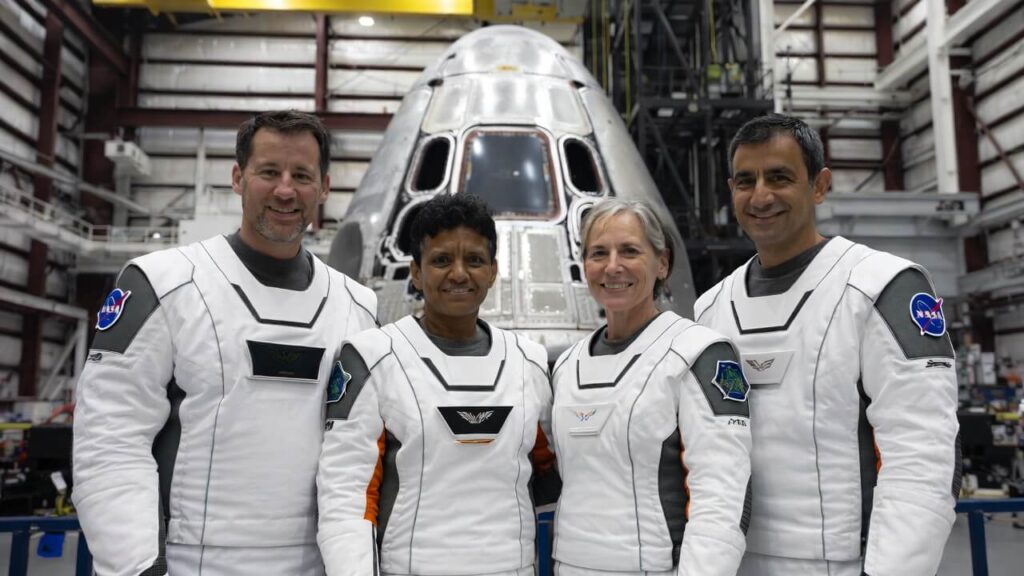
Four people will be aboard Orion on launch day, and their selection reflects both NASA’s evolving priorities and the international scope of the Artemis program.
Reid Wiseman serves as commander. A decorated Navy test pilot and former International Space Station commander, Wiseman brings sharp situational awareness and the calm that comes from two previous spaceflights. Victor Glover, the mission pilot, made history as the first Black astronaut to complete a long-duration ISS mission — a signal of the demographic shift that defines this new era of space exploration.
Christina Koch, mission specialist, holds the record for the longest single spaceflight by a woman and will become the first woman to travel to the vicinity of the Moon. That fact carries genuine cultural weight, not just symbolic value. And Jeremy Hansen, a Canadian Space Agency astronaut and Royal Canadian Air Force fighter pilot, will become the first non-American to travel to the lunar neighborhood — a milestone that underscores the vital role of international partnerships in Artemis.
These four have been preparing for years. Crew quarantine began February 20, 2026, just weeks before launch. The physical and psychological weight of that quarantine period is easy to underestimate. It’s not merely a precaution against illness — it’s the moment the mission becomes real.
The Rocket Behind the Artemis II Mission: Why SLS Is Extraordinary
The Space Launch System is, by several engineering measures, the most powerful rocket ever built and successfully flown. Generating approximately 8.8 million pounds of thrust at liftoff, it surpasses even the Saturn V rockets of the Apollo era in total thrust output. That kind of raw power isn’t engineered for vanity — it’s the physical requirement for sending a spacecraft heavy enough to keep humans alive all the way to the Moon and back.
The SLS Block 1 configuration that will power Artemis II consists of:
- Two solid rocket boosters (derived from Space Shuttle heritage) providing approximately 3 million pounds of thrust each during the first two minutes of flight
- A core stage burning liquid hydrogen and liquid oxygen through four RS-25 engines — the same engine family that powered the Space Shuttle
- The Interim Cryogenic Propulsion Stage (ICPS) with a single RL-10 engine, responsible for the critical translunar injection burn
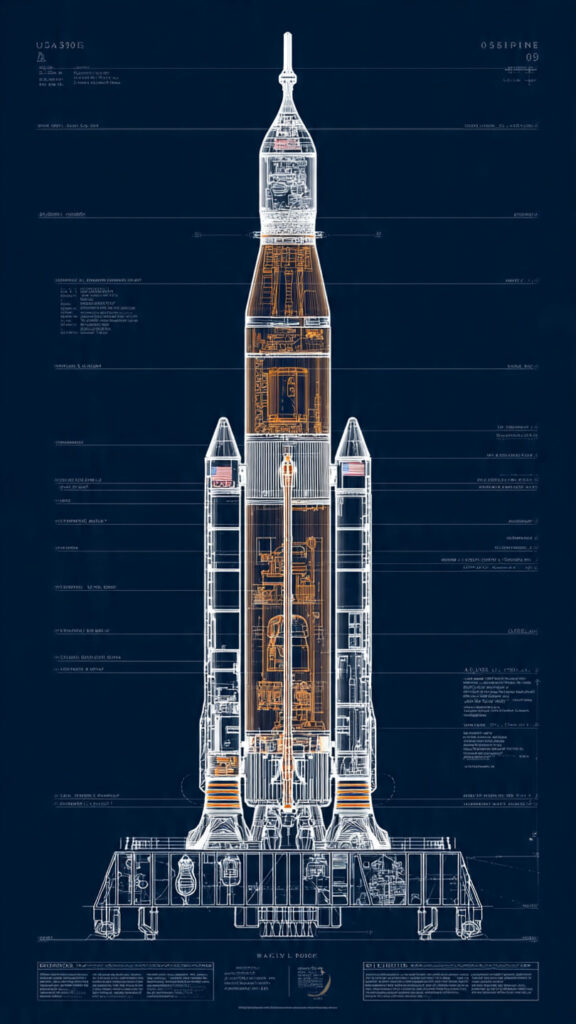
Sitting atop all of this is Orion, built by Lockheed Martin, featuring a crew module for four astronauts and a service module provided by the European Space Agency. The ESA service module handles propulsion, power generation, and thermal control during the mission — a genuine transatlantic partnership embedded in the hardware.
One of the more quietly significant stories heading into launch involves hydrogen seals. Engineers spent months addressing propellant leaks discovered during wet dress rehearsal preparations. New seals were installed, and wet dress rehearsals conducted February 17–19, 2026, successfully loaded over 700,000 gallons of liquid hydrogen and liquid oxygen without incident. The kind of grinding technical work that rarely makes headlines is, in fact, what makes launches possible.
Wet Dress Rehearsals and the Road to Launch
Most people don’t think much about what happens in the weeks before a rocket launch. They should.
The SLS rocket rolled out to Pad 39B on January 17, 2026 — a slow, methodical journey of about six kilometers that took roughly twelve hours and involves a crawler-transporter moving at walking speed. Once at the pad, engineers began an extended countdown demonstration campaign, intentionally stopping the clock and practicing anomaly responses.
The February wet dress rehearsals were the final major technical hurdle before launch. Teams loaded cryogenic propellants into all four vehicle stages, cycled through countdown procedures to within seconds of ignition, and then safely drained and repressurized the tanks. These rehearsals don’t just validate hardware. They train the hundreds of launch controllers, flight directors, and support engineers whose split-second decisions during an actual countdown matter enormously.
Post-rehearsal, engineers needed to retest certain safety systems on the pad — a standard step after handling large quantities of cryogenic propellants. That work was underway through late February, with the launch window opening March 6.
Weather, technical anomalies, or range conflicts could shift that date. Space is not a business that rewards impatience. But the technical trajectory, as of the wet dress rehearsal results, is strongly positive.
Why This Matters Beyond NASA: The Global Stakes of Artemis
The United States isn’t the only nation watching Artemis II with intense interest. China’s lunar ambitions are accelerating — the China National Space Administration has announced its own crewed lunar landing program targeting the early 2030s. Russia, despite its diminished space program, maintains symbolic investment in lunar exploration. India’s Chandrayaan-3 mission successfully soft-landed near the lunar south pole in 2023, demonstrating new competence in cislunar navigation.
Against this backdrop, Artemis II isn’t just about science or national pride. It’s about demonstrating that democratic, open-science space coalitions — NASA, ESA, JAXA, CSA — can execute complex crewed lunar missions reliably and sustainably. The Artemis Accords, which now include over 40 signatory nations, establish norms for peaceful lunar exploration and resource utilization. Whether those norms hold depends partly on whether the technical program that underpins them actually works.
There’s also an economic dimension that rarely gets enough attention. Deep-space human spaceflight is an engine for downstream technology development — from advanced life support to radiation-hardened electronics to precision navigation systems. The countries and industries that master these capabilities first tend to hold structural advantages in aerospace, defense, and high-tech manufacturing for decades.
What Comes After: Artemis III and the Path to the Lunar Surface
Artemis II is not the destination. It’s the gate.
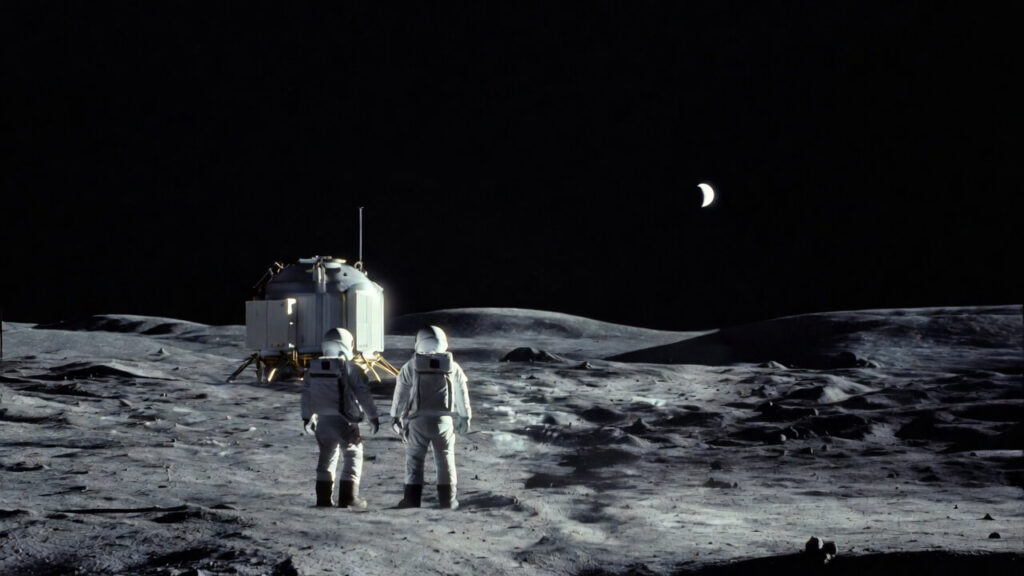
Artemis III, currently targeting 2028, will attempt the first crewed lunar landing since Apollo 17. The mission will use SpaceX’s Starship as a Human Landing System — a partnership that has faced technical scrutiny but represents a genuine paradigm shift in how lunar surface access gets architected. Starship will land two Artemis astronauts on the lunar south pole, a region of particular scientific interest because of confirmed water ice deposits in permanently shadowed craters.
Beyond Artemis III, NASA and its partners are building the Lunar Gateway — a small space station in lunar orbit that will serve as a staging point for surface expeditions. Gateway components have already been contracted, with international partners contributing modules, habitation systems, and logistics support.
The vision, fully realized, is a sustained human presence on and around the Moon — not flags and footprints, but science stations, resource extraction research, and eventually a proving ground for the technologies that will carry humans to Mars.
It starts, concretely, with four people sitting atop the world’s most powerful rocket on a Florida launchpad sometime in March 2026.
How to Watch the Artemis II Launch Live
NASA will broadcast the Artemis II launch live across multiple platforms. The agency’s official YouTube channel (youtube.com/NASA) and website (nasa.gov/artemis) will carry full coverage including pre-launch commentary, launch, and mission updates. The NASA app, available on iOS and Android, provides real-time mission tracking.
For deeper technical engagement, NASA TV’s media channel carries unedited mission audio, which is something that veteran space watchers find genuinely valuable. You’ll hear the actual communication between mission control and crew, without broadcast commentary overlaid.
Given the historic nature of this flight, major streaming services and broadcast networks are expected to carry live coverage. Worth setting a reminder now.
Conclusion: The Artemis II Mission Is the Moment That Changes Everything
The Artemis II mission represents more than a successful test flight or a bureaucratic milestone on a program timeline. It represents the answer to a decades-long question: after all the budget battles, the technical setbacks, the shifting political priorities, and the passage of time, can we actually do this again?
The wet dress rehearsals say yes. The hardware says yes. The crew is in quarantine and ready.
Space exploration tends to feel abstract until the engines ignite. In a few weeks, four human beings will climb into a capsule, sit atop 8.8 million pounds of thrust, and go somewhere no one has gone in over fifty years. Whatever your relationship to science or technology or national identity, that moment will be worth watching.
Follow this blog for ongoing Artemis program updates, technical deep-dives on the SLS and Orion systems, and full launch day coverage. You won’t want to miss what comes next.
Support EvidentWeb

How Does the Facebook Algorithm Work in 2026? Master It and Beat It
February 14, 2026
Wondering how does the Facebook algorithm work in 2026? Decode the 4 core steps, Reels ranking, and proven tips to…