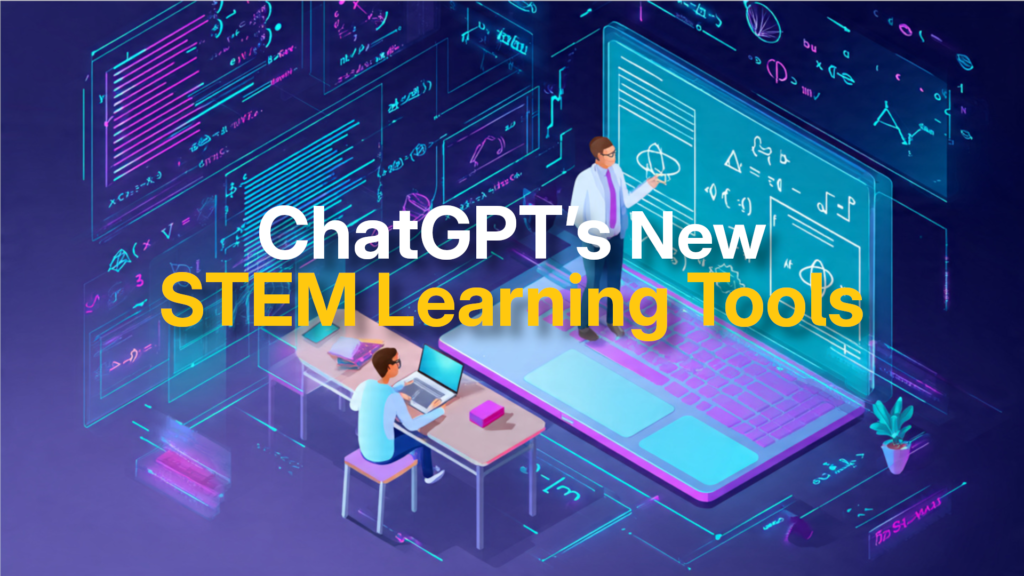
ChatGPT Introduces New STEM Learning Tools — A New Era for Math and Science Education
Artificial intelligence is rapidly transforming how people learn. Over the past few years, AI-powered assistants have moved beyond simple chatbots and become powerful learning tools for students around the world. One of the biggest developments in this space comes from OpenAI, the company behind ChatGPT.
According to the official OpenAI announcement, ChatGPT introduced new tools designed specifically to help users learn STEM subjects — science, technology, engineering, and mathematics — in a more interactive and engaging way. These features are designed to turn ChatGPT into something more than a question-answering bot. Instead, it aims to function like a personal AI tutor that helps students explore complex concepts step by step.
For students who struggle with subjects like algebra, physics, or calculus, these new tools could make learning more intuitive and accessible than ever before. But what exactly are these tools, and how do they work?
Let’s take a closer look.
What Are ChatGPT’s New STEM Learning Tools?
The new STEM learning tools in ChatGPT are designed to make technical subjects easier to understand through interactive explanations and guided learning.
Instead of simply giving an answer to a question, ChatGPT can now guide students through the learning process. It can break down complicated ideas into smaller steps, provide hints when users get stuck, and encourage them to think through problems logically.
Another major improvement is the ability to present visual and conceptual explanations for mathematical and scientific formulas. These interactive elements allow users to see how formulas behave and understand how different variables affect results.
The goal is simple: help students understand concepts deeply rather than memorizing answers.
Key Features of the New STEM Learning Tools
Interactive Math and Science Explanations
One of the most interesting features is the ability to explore formulas and scientific principles in a more visual way.
Many STEM concepts rely heavily on equations and relationships between variables. Instead of simply displaying a formula, ChatGPT can now show how these relationships work conceptually. This allows students to understand why formulas behave the way they do.
For example, when learning about physics formulas or algebraic equations, students can ask ChatGPT to explain how each variable affects the final result.
This approach helps turn abstract formulas into understandable ideas.
Study Mode: ChatGPT as an AI Tutor
Another powerful feature is something often referred to as Study Mode.
Rather than giving direct answers immediately, ChatGPT can guide users through a problem-solving process. It may ask questions such as:
- “What do you think the next step should be?”
- “Which formula might apply here?”
- “Can you simplify this part first?”
This method encourages active learning, which educational research shows is much more effective than simply reading answers.
In many ways, this makes ChatGPT function like a private tutor that is available at any time.
Step-by-Step Problem Solving
Complex problems in subjects like mathematics and physics often require several steps to reach a solution. The new tools allow ChatGPT to present these steps clearly and logically.
Instead of showing only the final answer, the system can demonstrate:
- The relevant formula
- How to substitute values
- Intermediate calculations
- The final solution
For students preparing for exams or trying to understand homework problems, this structured explanation can make a huge difference.
Examples of STEM Topics ChatGPT Can Help With
The learning tools can be applied to many topics across mathematics and science. Some common examples include:
Mathematics
- Algebra equations
- Quadratic functions
- Geometry formulas
- Probability and statistics
Physics
- Kinetic energy
- Ohm’s law
- Newton’s laws of motion
- Wave speed and frequency
Chemistry
- Gas laws
- Chemical reactions
- Molecular structures
Computer Science
- Programming concepts
- Algorithms
- Data structures
Because ChatGPT is conversational, users can also ask follow-up questions if something isn’t clear.
How Students Can Start Using These Tools
One of the best things about these learning features is how easy they are to use.
Anyone can start using them by following a few simple steps.
Step 1: Create or Log In to ChatGPT
First, visit the official ChatGPT website and sign in or create a free account.
Step 2: Ask a STEM Question
Once logged in, simply ask a question related to a STEM subject. For example:
- “Explain the Pythagorean theorem step by step.”
- “Help me solve this algebra equation.”
- “Teach me Ohm’s law like a beginner.”
Step 3: Request Guided Learning
To get the most out of the system, users can ask ChatGPT to act like a tutor. For example:
- “Teach me this concept step by step.”
- “Give me hints instead of the final answer.”
- “Quiz me on this topic.”
These prompts encourage a more interactive learning experience.
Free Plan vs Paid Plans
Many people wonder whether these learning tools require a paid subscription.
The good news is that most core learning features are available on the free version of ChatGPT. This means students can already use the platform for tutoring and explanations without paying.
However, there are some differences between plans.
Free Plan
- Access to ChatGPT and basic learning tools
- Limited daily usage
- Slightly slower responses during busy times
Paid Plans (Plus / Pro)
- Higher usage limits
- Access to more powerful AI models
- Faster response times
For most students, the free version is already powerful enough for everyday learning.
Why This Matters for Education
The introduction of AI-powered learning tools represents a major shift in education.
Traditionally, students rely on textbooks, classroom lectures, and occasional tutoring sessions to understand complex topics. However, not everyone has access to personalized help when they need it.
AI systems like ChatGPT are changing this by providing instant guidance at any time.
Students can ask questions whenever they encounter difficulties, receive explanations in simple language, and explore topics at their own pace.
This type of personalized learning experience could make STEM education more accessible worldwide.
Limitations and Responsible Use
Despite its impressive capabilities, ChatGPT is not perfect.
Like any AI system, it can sometimes make mistakes or produce incomplete explanations. For this reason, students should always double-check important information and compare answers with trusted sources.
Teachers and educational institutions also remain essential. AI tools should be viewed as learning assistants, not replacements for real educators.
When used responsibly, however, these tools can significantly enhance the learning process.
Final Thoughts
The latest learning features in ChatGPT demonstrate how artificial intelligence is evolving beyond simple automation tools. By offering interactive explanations, guided problem-solving, and conceptual learning support, ChatGPT is becoming a powerful assistant for students studying STEM subjects.
While AI cannot replace traditional education, it can make learning more flexible, personalized, and accessible.
As tools like ChatGPT continue to improve, they may play an increasingly important role in helping students around the world understand complex ideas and develop critical problem-solving skills.
For anyone studying mathematics, science, or technology, the future of learning is becoming more interactive — and AI is a big part of that transformation.
🔗 You Might Also Like
Microsoft Copilot Cowork: The Powerful AI Agent That Actually Does Your Work For You
📅 March 10, 2026
Microsoft Copilot Cowork is the agentic AI that takes real action inside Microsoft 365. Here’s exactly how it works, what it does, and why it matters in 2026.
Read Full Breakdown →References
- OpenAI. (2026). New ways to learn math and science in ChatGPT.
https://openai.com/index/new-ways-to-learn-math-and-science-in-chatgpt/ - OpenAI.(2026). New ways to learn math and science in ChatGPT(video).
https://openai.com/index/new-ways-to-learn-math-and-science-in-chatgpt/?video=1171630430 - https://openai.com/index/understanding-ai-and-learning-outcomes/


🤩