The Quiet Semiconductor Giant Racing Toward a Trillion Dollars
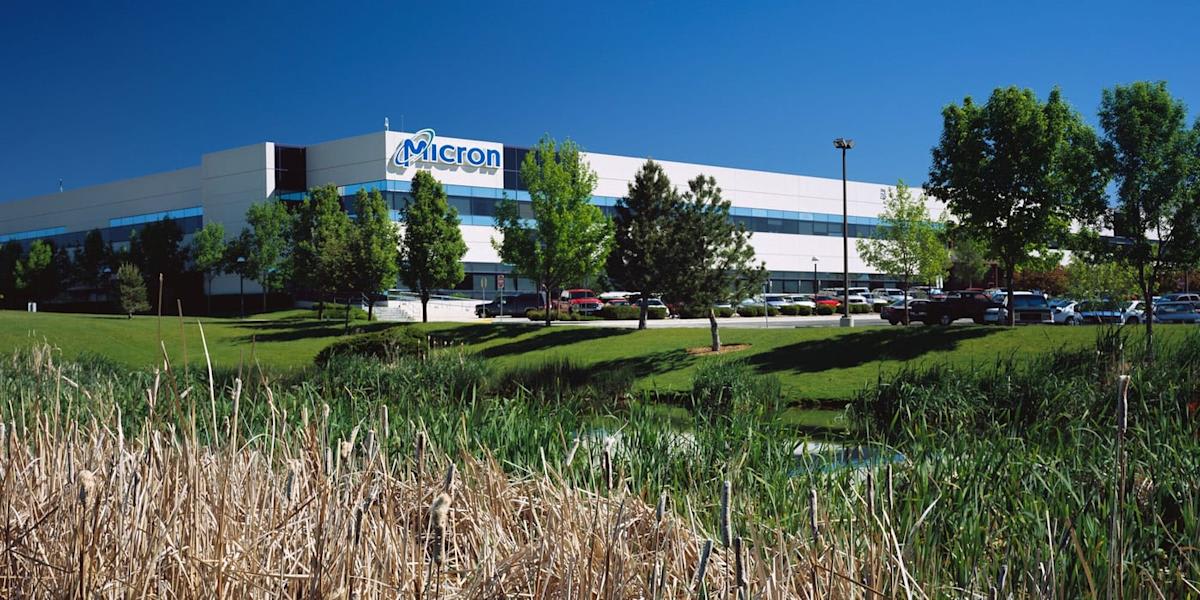
For decades, Micron Technology lived in the shadows of flashier chipmakers. It supplied the memory that powered the digital world but rarely captured headlines. That era may be ending.
As artificial intelligence reshapes global computing, Micron is emerging as one of the most strategically critical companies in the semiconductor supply chain. Fueled by an unprecedented AI-driven memory supercycle, record earnings, and fully booked high-bandwidth memory (HBM) production through 2026, Micron now sits on a credible path toward a $1 trillion market capitalization—more than double its current valuation.
This isn’t speculative hype. It’s the result of hard constraints, locked-in demand, and a structural shift in how AI systems consume memory.
Record Fiscal Q1 2026 Results Signal a Structural Shift
Micron’s fiscal first-quarter 2026 earnings, announced in December 2025, stunned even seasoned semiconductor analysts.
Revenue surged to $13.64 billion, up 57% year-over-year, while net income reached $5.24 billion. Gross margins climbed beyond 56%, a level once considered unattainable for a memory manufacturer.
Even more striking was forward guidance. For fiscal Q2, Micron projected $18.7 billion in revenue with margins approaching 68%—numbers that place it closer to Nvidia’s profitability profile than the historically cyclical memory sector.
CEO Sanjay Mehrotra confirmed what investors had been waiting to hear: Micron’s entire 2026 HBM capacity is already sold out, with pricing and volumes contractually locked in. Due to industry-wide supply constraints, the company can only fulfill half to two-thirds of customer demand, granting enormous pricing power.
In AI systems, memory is no longer a commodity. It’s the bottleneck.
Why High-Bandwidth Memory Is the New AI Chokepoint
Modern AI accelerators—such as Nvidia’s Blackwell GPUs—are only as powerful as the memory feeding them. Training large language models requires enormous data throughput, and standard DRAM simply can’t keep up.
Micron’s HBM3E memory delivers up to 30% better power efficiency than competing solutions, a critical advantage as hyperscalers battle rising energy costs. With HBM shortages forcing GPU production cuts of up to 40%, memory suppliers now dictate the pace of AI deployment.
Gaming GPUs and consumer devices are already being deprioritized, further tightening supply and reinforcing Micron’s leverage across pricing negotiations.
This is not a short-term spike. It’s a systemic imbalance.
The Memory Supercycle That Could Last to 2028
According to TrendForce, the semiconductor industry has entered a prolonged memory upcycle unlike anything seen before. In early 2026 alone, DRAM prices jumped 55–60% quarter-over-quarter, while NAND Flash rose 33–38%.
Across the full year, DRAM pricing could increase by more than 70%, driven almost entirely by AI workloads. Analysts now forecast the HBM market to reach $100 billion by 2028, two years earlier than previous expectations.
Unlike past cycles—driven by smartphones or PCs—this surge is anchored in AI data centers, cloud infrastructure, and sovereign computing investments. These are long-term commitments, not discretionary upgrades.
Technology Roadmap: From HBM3E to HBM4 and Beyond
Micron’s momentum didn’t happen overnight. It reflects years of aggressive R&D investment and manufacturing discipline.
The company plans to begin HBM4 mass production by mid-2026, followed by HBM4E in 2027–2028, leveraging its 1-gamma DRAM process and advanced EUV lithography. These technologies allow higher density, better yields, and superior energy efficiency—key differentiators as AI models grow larger and more power-hungry.
Beyond data centers, Micron is positioning itself for the next wave of edge AI. Its 256-layer NAND and LPCAMM2 memory target AI-enabled laptops and on-device inference, aligning with expected operating system upgrades in 2026 and 2027.
Analyst Outlook: Revenue Doubling, Earnings Multiplying
Wall Street has begun recalibrating its expectations.
TD Cowen recently raised its Micron price target from $300 to $450, citing deepening HBM shortages and sustained pricing strength into late 2026. Other models project fiscal 2026 earnings per share around $33, rising to $41.50 in 2027—nearly four times current run-rate levels.
At a 30x forward P/E, consistent with trillion-dollar peers like Nvidia, TSMC, and Broadcom, Micron’s valuation would exceed $1 trillion. Even more conservative metrics suggest upside, with some analysts arguing Micron’s 12.3 forward P/E understates its AI exposure.
Manufacturing at Scale: The $200 Billion U.S. Bet

To sustain growth, Micron is betting heavily on domestic manufacturing.
The company has committed $200 billion to new U.S. fabs in Idaho and New York, addressing both supply shortages and geopolitical risks. These facilities will significantly expand HBM and DRAM capacity later this decade, strengthening relationships with U.S. hyperscalers and defense-linked AI initiatives.
Smaller strategic acquisitions in advanced packaging or silicon photonics could further accelerate Micron’s roadmap, especially as memory-compute integration becomes more critical.
Risks That Could Derail the Trillion-Dollar Dream
No investment thesis is without risk.
Aggressive capital expenditure could pressure free cash flow if demand unexpectedly softens. Samsung and SK Hynix remain formidable competitors in HBM, and any breakthrough could shift market share.
Consumer electronics weakness may weigh on NAND pricing. However, AI data centers already account for nearly 90% of HBM demand, insulating Micron from broader macro swings.
At current valuation multiples, downside risk appears limited compared to other AI beneficiaries.
Investment Case: A Supercycle, Not a Speculative Bubble
Micron’s rise isn’t driven by hype—it’s driven by physics, power constraints, and data gravity.
As AI models grow larger, memory becomes the limiting factor. With sold-out capacity, technological leadership, and long-term contracts in place, Micron has transformed from a cyclical memory supplier into a foundational AI infrastructure company.
If current trends hold, Micron joining the trillion-dollar semiconductor club by 2026 looks not just possible—but increasingly inevitable.
Published by evidentweb.com
Pingback: Is WhatsApp Really Secure? The Uncomfortable Truth About End-to-End Encryption - The Evident