Introduction
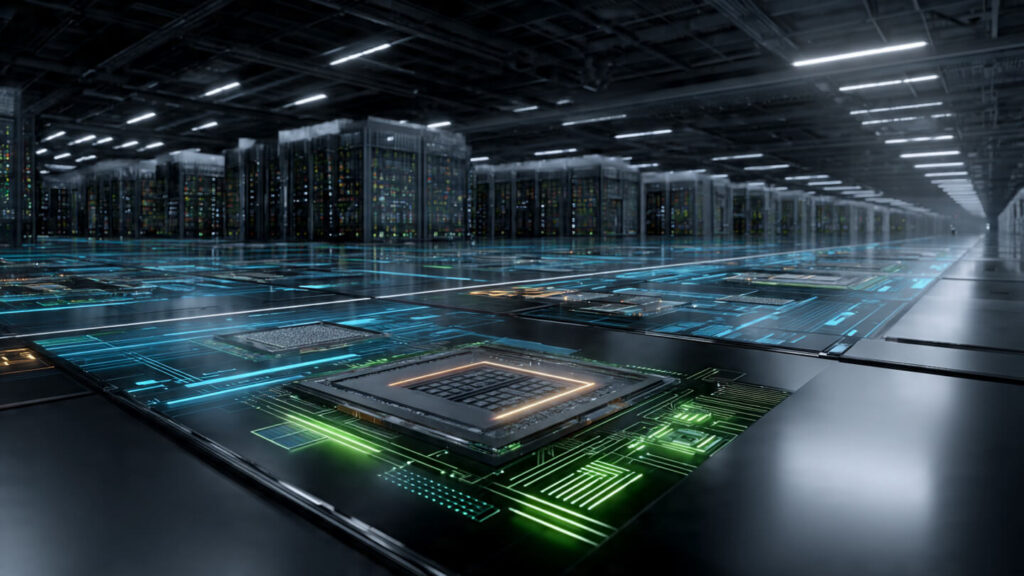
When NVIDIA announced at CES 2026 that there would be no new gaming graphics cards this year—the first pause in three decades—the message was clear. The company that built its empire on making video games look prettier has fundamentally changed course. Jensen Huang isn’t betting on gamers anymore. He’s betting on artificial intelligence, and the numbers suggest he’s right.
The Santa Clara-based chip giant just posted $39.3 billion in revenue for Q4 alone, with AI accelerators accounting for an overwhelming majority. Gaming? It’s dropped to roughly 8% of total revenue, down from 35% just four years ago. This isn’t a temporary shift. It’s a complete strategic overhaul, and the implications stretch far beyond disappointed PC gamers waiting for RTX 60 cards that aren’t coming.
The Gaming Drought Nobody Expected
For the first time since the company’s founding in 1993, NVIDIA won’t release a new gaming GPU architecture in 2026. No RTX 50 “Kicker” refresh. No RTX 60 series. The reason? Memory shortages, sure—but that’s only part of the story.
The real issue is priority. When you’re shipping 72-GPU Blackwell racks to OpenAI and hyperscalers willing to pay exponentially more than any gamer ever would, the decision becomes straightforward. Why allocate precious HBM (high-bandwidth memory) to a $1,200 graphics card when the same memory can go into a $30,000 AI accelerator?
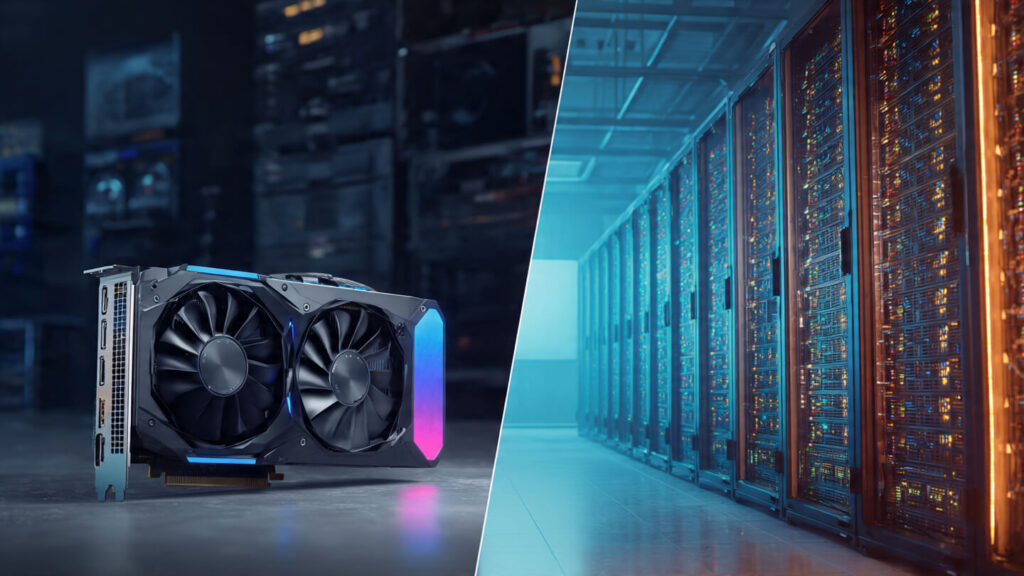
NVIDIA’s gaming division isn’t dead, but it’s certainly on life support. DLSS 4.5 has expanded to over 400 games and applications, and GeForce Now is getting Linux and Fire TV support. These are maintenance moves, not innovation. The company is keeping the lights on while the real action happens elsewhere.
Where the Money Actually Is: AI Dominance
Here’s what should terrify NVIDIA’s competitors: the company controls 92% of the data center GPU market, 95% of AI training workloads, and 88% of inference tasks. That translates to $49.7 billion out of the total $54 billion GPU market.
The full fiscal year 2025 numbers tell an even more dramatic story. Total revenue hit $130.5 billion—up 114% year-over-year—with data center sales alone reaching $115 billion. That’s double the previous year. Meanwhile, gross margins sit at 73.5%, the kind of profitability that makes most tech companies weep with envy.
This didn’t happen by accident. NVIDIA has spent years building an unassailable moat around its AI business through the CUDA software ecosystem. Developers trained on CUDA don’t easily switch to AMD or Intel alternatives. It’s a lock-in strategy that Microsoft would admire.
The Roadmap That Changes Everything
What separates NVIDIA from competitors isn’t just current dominance—it’s the ruthless predictability of what’s coming next. Jensen Huang promised “no surprises” with the annual roadmap, and he’s delivering.
Blackwell Ultra (Shipping Now)
The Blackwell platform is already ramping, with GB300 configurations shipping to major cloud providers. Top hyperscalers are deploying 72-GPU Blackwell racks at three times the rate they did with the previous Hopper generation. NVIDIA projects Blackwell could generate 50 times the revenue potential of Hopper for cloud AI services.
These aren’t incremental improvements. A single Blackwell NVL72 rack delivers inference capabilities that would have required an entire data center just a few years ago.
Rubin (H2 2026)
This is where things get genuinely wild. The Rubin platform, launching in the second half of 2026, features:
- R200 GPU: 288GB of HBM4 memory running at 22TB/s bandwidth
- 50 petaFLOPS of FP4 inference performance per chip
- NVLink 6: 260TB/s total rack bandwidth—more than the entire global internet’s backbone capacity
- Vera Rubin NVL72: 72 GPUs delivering 3.3x Blackwell’s inference speed
The first gigawatt of OpenAI’s planned 10-gigawatt AI infrastructure will run on Rubin starting mid-2026. We’re talking millions of GPUs in a single deployment.
Rubin Ultra (H2 2027) and Feynman (2028)
NVIDIA isn’t slowing down. Rubin Ultra in 2027 brings NVL576 racks—yes, 576 GPUs in a single system—running about four times faster than standard Rubin and 21 times faster than Blackwell. The VR300 chip will achieve 1.1 exaFLOPS of FP4 performance..

Then comes Feynman in 2028, promising a 5-20x leap over Rubin specifically optimized for agentic AI and robotics. The annual cadence of “scale up, then scale out” means every year brings massive performance improvements followed by deployment-focused refinements.
Strategic Partnerships That Matter
NVIDIA’s partnerships reveal where the future is heading:
OpenAI: $100 billion investment for 10GW of AI data centers, with the first gigawatt on Rubin architecture
Intel: $5 billion partnership for x86-NVLink hybrid systems, strengthening U.S. chip sovereignty
Groq: $20 billion licensing deal for LPU inference technology, enhancing real-time AI capabilities
Mercedes-Benz: Alpamayo autonomous vehicle platform debuting in the CLA model
These aren’t speculative R&D plays. They’re massive capital commitments from partners betting their futures on NVIDIA’s roadmap delivering as promised.
The Competition Problem
AMD holds about 7% of the data center GPU market with its MI455 accelerators and has ties to OpenAI. Intel is pushing cost-focused alternatives and manufacturing capabilities. Qualcomm targets lower-end AI workloads.
But the real threat comes from custom ASICs—application-specific integrated circuits—being developed by Google, Amazon, and Microsoft. These companies are building chips optimized for their specific AI workloads, and analysts project this could erode NVIDIA’s market share to 65-70% by 2030.
Still, that’s a long way from dethroned. The CUDA moat remains formidable, and switching costs are enormous once infrastructure is built around NVIDIA architecture.
The Challenges Nobody’s Talking About
This AI-first strategy isn’t without serious risks.
Power consumption is becoming absurd. Rubin racks operate at 1400W thermal design power, and exaFLOPS-scale systems will require dedicated power infrastructure. Data centers are becoming power plants.
Geopolitics complicates everything. U.S.-China tensions limit H20 chip sales to Chinese markets, forcing NVIDIA to develop region-specific variants. Meanwhile, sovereign AI initiatives in places like Saudi Arabia (500MW AI factories) create fragmented markets.
Memory shortages aren’t just delaying gaming cards—they’re a genuine bottleneck for AI expansion. HBM4 production can’t scale fast enough to meet demand.
And then there’s the antitrust scrutiny. When you control 92% of a critical market, regulators start asking uncomfortable questions. The Groq licensing deal and Intel partnership seem designed partly to deflect monopoly concerns.
What This Means for the Industry
The message from NVIDIA is unambiguous: AI is the future, and everything else is legacy business. Gaming served its purpose—it funded R&D and built the company into a powerhouse—but the AI opportunity dwarfs anything gaming could ever provide.
Jensen Huang talks about $10 trillion in global infrastructure being reshaped for AI across data centers, robotics, and autonomous vehicles. The company’s market cap exceeded $5 trillion in early 2026, and analysts project the stock could hit $223 with 72% margins maintained through the AI boom.
For competitors, the window is closing. NVIDIA’s annual product cadence means they’re not just ahead—they’re accelerating away. Catching up requires not just matching current performance but anticipating what Rubin Ultra and Feynman will deliver years from now.
Final Thoughts
The gaming community has every right to feel neglected. Enthusiasts who built NVIDIA into a household name are watching the company pivot away from them entirely. But from a business perspective, the decision is rational to the point of being obvious.
When a single AI rack generates more revenue than thousands of gaming GPUs, and when customers like OpenAI are writing checks with more zeros than NVIDIA probably imagined possible a decade ago, you follow the money. Gaming will get table scraps—maintenance updates, software improvements, maybe a token product launch when memory constraints ease—but the real innovation is happening in AI accelerators.
Whether this gamble pays off long-term depends on whether the AI boom sustains or becomes another bubble. But with roadmap commitments through 2028, massive partnerships already signed, and infrastructure being built around their chips, NVIDIA has made its bet.
And right now, the house is winning.
☕ Buy Me a Coffee